Friday, April 22, 2011

Sunnyvale "Youth and Horses" Group Graduates!


On Tuesday, April 12 the first session of "Youth & Horses" concluded. Eight high school students showed their horsemanship skills both on the ground and in the saddle as family, friends, public safety officers and school administrators watched with big smiles.

Each week, the students and their mentors were transported from Fremont High School in Sunnyvale to DreamPower Horsemanship in Gilroy for a 90-minute lesson. The drive time was used to inspire the students to think about their future with a variety of presentations and workshops. During the nine-week program, students learned life skills such as responsibility, patience, work ethic, teamwork and communication while learning to handle and ride horses. They worked with both full sized horses, miniature horses and a miniature donkey.

After the horsemanship demonstrations, Officer Jim Davis served everyone a delicious meal of hotdogs, burgers, chips, watermelon and lemonade. Chef Cecelia Garza of Wild Tastes Catering provided delicious gourmet cupcakes to top off the celebration. Each student was honored with an award highlighting their strengths and each was given a framed photograph taken during the program.

Nine DreamPower volunteers made this program possible. Special thanks to the volunteers and mentors who came every afternoon for nine weeks to work with these students! Thanks to Chester, Rocky, Classy and Red, for teaching the students how to ride! And thanks to Choco, Patches, Trigger and Zachary, for helping the students to learn about working with horses on the ground.
Dori Fontaine of the Sunnyvale Department of Public Safety and Rob Schulze of the Reach Potential Movement coordinated the eight students and eight mentors who participated in the program.

Riding lessons were taught by NARHA Instructors-In-Training Lisa Renae Nelson and Dori Fontaine, under the supervision of NARHA Registered Instructor Martha McNiel. Horsemanship lessons with the mini's were led by NARHA Registered Instructor Melissa Abbey.


The program, part of the Sunnyvale Youth Mentoring Initiative, was co-coordinated by the Sunnyvale Department of Public Safety and Reach Potential Movement and was made possible through contributions from several generous sponsors: Cintas Document Management, Sonitrol Security Systems, Royal Coaches, Sports Basement, Wells Fargo Advisors, St. Luke Lutheran, Century Graphics, Royal Coaches Tours, Summit Riders Horseman's Association, Norm and Donna Betts, and Brad Frederickson.  Thank you for your support!

Monday, April 11, 2011

DreamPower Park: Bring Your Picnic Basket!

DreamPower moved to California Stables on February 1, 2007. Those of you who were around then may remember the enormous pile of manure, brush and junk that occupied the area in front of the wash rack barn, under the big oak tree, on the way to the DreamPower barn. Over the past several years that area has gradually been cleaned up. Children's Camp has met under the oak tree for Arts and Crafts and the Horses for Heroes with Heart folks met under that tree for lunch. That lunch prompted Garry Stauber to make it his project to turn that area into a nice meeting and eating area. Don van Straaten went to the San Martin Lions Club and asked if they would give DreamPower some used picnic tables from the Lions Hall. The Lions said "no." Rather than giving DreamPower used picnic tables, they said they would buy six new picnic tables and give them to DreamPower!

Ramon helps to spread the sand.
Garry levels the sand around the picnic area.
So - this past week-end - the project came together. Ramon Juarez was recruited to help Garry get the site ready.  They loaded all the remaining junk on the tractor and hauled it away. They drug the area and levelled the ground. They placed landscaping cloth, spread the wood chips, added landscaping touches and brought in sand. Garry dug a fire pit for bar-b-ques and put bricks around it. Flowers were planted around the oak tree. By Saturday night, the entire site was beautiful and ready for the picnic tables to come the following day.


Bricks are laid, flowers are planted, ready for the tables!

Garry and Ramon pat each other on the back for a job well done!

On Sunday, Don and Dirk van Straaten pulled up in their van with six state-of-the-art picnic tables packed inside.
Don and Dirk start assembling picnic tables.


Power drills in hand, they started assembling the tables, donated by the San Martin Lions Club.
These guys know how to build tables!


One, two, three, four, five, six tables!

This is how you build a picnic table.


The end result is a beautiful picnic area where we can have groups, meetings, camps, lunch, and just enjoy the beauty of nature under a spreading oak tree!
Garry, Dirk and Don celebrate a completed project!


The next time you see Garry, Ramon, Don, Dirk, or any of the San Martin Lions, please tell them all thank you for giving us all a beautiful new space to enjoy!

And here is "DreamPower Park!"  Bring your picnic basket!

Sunday, February 27, 2011

How To Make A Therapy Horse

Kim and Wishe on the day he came to DreamPower.
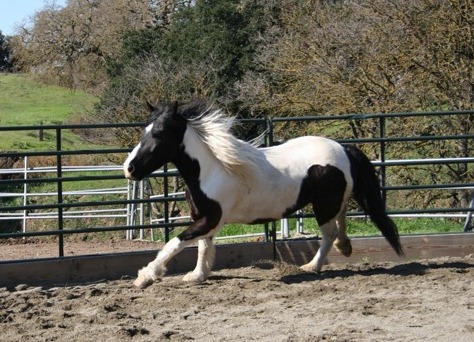
I am very excited to introduce "Captain Bingo" - the newest addition to DreamPower's wonderful herd of generous program horses.  Captain Bingo's given name is "Iwishewasagypsyvanner," know around the barn as "Wishe."  Wishe was raised and trained by Kim Johnson of Fresno, CA.  He officially joined DreamPower on February 24, 2011 through the generosity of the Whitlow Family Trust and Mary Adinamis.

Many people think that working in a therapeutic riding program is a job for an older horse that is not sound or cannot be ridden or has some health issues.  They think it is "easy" work.  After all, therapeutic riding horses do not typically run fast or jump high or slide to dramatic stops.

DreamPower lost two wonderful horses in the past two years.  Starbright was 28 and foundered as the result of cushing's disease.  T.C. died of cardiac failure at the age of 25.  Both of these wonderful horses worked at DreamPower up until the day they died.  As a result, students and clients and staff and volunteers were all deeply saddened by the loss of these two wonderful equine friends.

Captain Bingo
 We have been looking for one or two horses to fill the horse shoes of T.C. and Starbright for the past year. DreamPower gets offered 3 or 4 free horses each week. Each potential horse is evaluated for health status, soundness, temperament, attitude, training, age, size and geographic location.  While we were looking at this potential new horse, I received many emails and comments that DreamPower should not buy a new horse "because there are so many horses available right now that would make great therapy horses."  I was told, "Go to a rescue or a shelter in your area and rescue a horse.  They have many horses there that would make great therapy horses."  I understand the good intentions behind those comments, but I wanted to address the situation today.

DreamPower has rescued three horses in our eight years. Forest and Pete still work at DreamPower and Cory went on to find a more suitable home where his strong energy and big size were appreciated. (For those of you who were wondering, Angel is still in my backyard at my home, but she is a personal project and not a DreamPower horse.)  I believe there is a special role for rescued animals in therapeutic horsemanship programs.  But that is not the role we were looking to fill right now.  We were looking for a horse that can work every day, that can willingly and safely carry children with autism and veterans with PTSD and teen-agers with drug problems. We need a horse that is already well-trained and safe to walk, trot or canter independently or on a lead line.

Captain Bingo passed all the health and soundness tests.
Because DreamPower has limited funds, we cannot accept a horse with a health condition that is going to require special shoeing, ongoing medications, injections and other expensive "maintenance" items. A horse with a lot of special medical needs is beyond the financial reach of most therapeutic riding programs. A good therapeutic riding horse must be 100% sound every day, able to walk and trot (and canter if asked) every time it comes out of the stall.  A horse that is lame cannot teach or work in a therapy session. After all, how would you feel if it hurt to walk and you were made to walk around, limping, every time you went to work?

A good therapeutic riding horse is a combination of saint, counselor, priest (confessor willing to forgive the sins of many) and possesses the patience of Job. He must be calm and quiet by nature and not easily upset.  She must not be bothered by the anxiety, nervousness or unexpected actions of those around them.  A good therapeutic riding horse must be well-trained and willing to teach beginning riders who are often unbalanced and uncoordinated. The horse must respond to cues that are given but not respond to cues that are mistakes or unintended, and the horse must know how to tell the difference! Many of the best therapeutic riding horses are retired show horses or ranch horses who have had extensive training and have a good work ethic with lots of "real world" experience.

Garry Stauber trying out the new horse.
 We prefer the horses that work at DreamPower to be on the short side (for a horse). That means 15.2 horse hands or smaller for DreamPower. A horse that is taller than 15.2 can be intimidating for new riders and it can be difficult for volunteers and sidewalkers to be able to reach the client while they are mounted and can difficult to dismount riders in case of a problem.  We were looking for a horse between 8-15 years of age.  Old enough to be experienced but young enough to hopefully be around for many years to come.  It needed to be strong enough to carry adult riders but gentle enough for children.

DreamPower horses must be willing to accept toys, balls, bean bags and all sorts of strange things most horses do not encounter. They must be willing to let children play catch and basketball while riding on their backs, and to let riders wave their arms, turn in circles and do all kinds of exercises while on their backs.

Here is what it took to bring a new horse to DreamPower this week:
1. A previous owner (Kim Johnson) who trained a wonderful horse to be a responsive, well-behaved good citizen and gave him a lot of trail, horse camping, driving and "real world" experience. And who was willing to work with us and allow DreamPower a two-week trial period to try him out.
2. Donors who were willing to donate the money to purchase the horse. Because of the generosity of the Whitlow Family Trust and Mary Adinamis, DreamPower was able to purchase Captain Bingo. Also special thanks to Susan Stillman and Esperanza Martinez for their generosity and support of DreamPower's new horse.
3. Thanks to Bob Genisman for paying for the veterinary check.
4. Thanks to Janice Clare-Johnson and the Rotary Club of Gilroy who donated money for a new saddle for the new horse.
5. The new horse was picked up with a truck that was donated by Denise Manchester and completely overhauled and refurbished by the South County Country Dancers.
Dr. Ann Wimmer, DVM during the new horse vet check.
6. The horse was picked up and delivered by Martha McNiel and Melissa Abbey. It was an 11-hour day hauling the horse back to DreamPower. Kudos to me (Martha) for bravely driving over the Pachecho Pass with a "borrowed" horse in the trailer.
7. A veterinary health check by the wonderful folks at Tri-County Veterinary Hospital, who take such wonderful care of our horses and our program. They gave this horse an incredibly thorough veterinary check, to try to anticipate any possible foreseeable health problems that might make him unable to work in the future.  The vet check took a total of more than four hours and included a very thorough lameness exam and many radiographs. Lameness problems are the most common reasons horses stop working in therapeutic riding programs and we wanted to be sure there were no foreseeable problems that might result in predictable lameness.
8. A training and riding check by Garry Stauber, Martha McNiel, volunteers and students who practiced throwing balls, playing with toys, leading him and just "seeing what he would do" in a variety of situations he is likely to encounter while working at DreamPower.

Garry Stauber and Captain Bingo walk to the arena.
9. Allowing students and clients to ride and work with the new horse in very closely supervised sessions, to see if he would be happy and comfortable working with our clients.

I am so pleased to tell you that "Wishe" passed all of his tests with flying colors!  He got an "A+" for everything we asked him to do.  The veterinarians cleared him for health status and the staff passed him for training, temperament and attitude.

So that only left two things to do, to make him an official part of the DreamPower herd. First, he needed a name.  His given name is "Iwishewasagypsyvanner." (He is a 9-year-old paint/cob/Percheron cross but looks very much like a Gypsy vanner.)  But at DreamPower, we don't "wish" he is anything other than the wonderful horse that he is - we are thrilled with him, just the way he is! Literally hundreds of new names were suggested, but the name that stuck is "Captain Bingo."  "Captain" is in honor of the veterans he will serve in our Horses for Heroes program and "Bingo" is in honor of the San Martin Lions Club, who have been such generous financial supporters of DreamPower, through the proceeds of their Wednesday night bingo games!

Lastly, I have been ordering new tack that will fit our new large-size horse. The new saddle donated by the Rotary Club of Gilroy and Janice Clare-Johnson has arrived.  I have ordered a draft-size bridle and sidepull for his draft-size head and we are awaiting their delivery.

Woo-hoo!!  Thank you to everyone who made this possible.  And special thanks to Kim Johnson, who raised and trained a truly wonderful horse, who is now able to step into his new job at DreamPower with such ease and comfort.  Please join me in welcoming Captain Bingo to DreamPower!

Tuesday, February 8, 2011

National Treasure

DreamPower Horses for Heroes
GWOT Day at the Ranch
January 29, 2011

The Veterans


"I feel as though each one of these vets is a national treasure.  I really do feel that way." 
 --David Haley, Licensed Marriage and Family Therapist


"I can say what I really feel and not worry about your reactions. I can't do that anywhere else."
  --An OEF/OIF veteran


"I had forgotten how safe it feels to be here at this ranch with you guys."
--An OEF/OIF veteran


"I just feel so at home here. It is a safe place for me."
--An OEF/OIF veteran 


"I don't know what you guys do here but I can't shut him up for a day and a half after he's been here. He used to isolate a lot. I now have hope that I will someday get my husband back."
--The wife of an OEF/OIF veteran


"Thank you so much for putting together the Horses for Heroes event. It was the type of relaxing, learning event that I feel is an outstanding alternative to traditional therapy. I look forward to bringing more vets with me the next time this event takes place."
--An OEF/OIF Veteran and Veterans' Center Staff


"Horses for Heroes is a fantastic program for our returning veterans, and a great example of a therapeutic learning environment."
--Educational Researcher, UC Berkeley 
The Staff and Volunteers
 "It was truly inspiring to see you all in action (including of course Red, Two Lips, et al!). Your dedication and caring, combined with your remarkable professional expertise, makes for a wonderful program. Thanks for all the great work you do for and with our veterans."
--Educational Researcher, UC Berkeley


Friends, Fun, Food . . . and Horses!

DreamPower Horses for Heroes events are offered at no cost to veterans and military personnel and their families. These special events and life-saving, life-changing services are made possible through the generous donations of individuals, businesses and organizations who want to say to our vets, "Thank you for your service!"  For more information or to make a donation to DreamPower Horses for Heroes, contact
dreampowerhorsemanship at hotmail dot com.

To all veterans we want to say, "Thank you for your service!" 

Very special thanks to Nathan Trujillo for taking the photos and sharing them with us.  More information about Nathan Trujillo Photography can be found at http://www.flickr.com/people/nathantrujillophotography/.

Friday, January 21, 2011

A Very Good Day

One of my goals for this blog was to give you a "behind the scenes" look at DreamPower, to invite you into the daily workings of a therapeutic horsemanship program. As I left the ranch tonight (towing a horse trailer full of miniature horses and heading to the South County Planning Team meeting) I thought, "I love this work! I am so blessed!" I'd like to share today with you, because it was a pretty "typical" day.

The first class of the day was a group of students from the Santa Clara County Office of Education Adaptive Physical Education Department. DreamPower's good friend Randy Klein brought a vanload of students, including a few we already knew. This photo is one of the students jumping with Zachary. Class with these students and the mini's is always a lot of fun!

After the first class, we had our supervision/staff meeting for our psychotherapy interns and therapists. In the middle of our staff meeting, we heard a pack of coyotes trying to "bait" Bear (Garry Stauber's border collie) into running out into the field, so the pack could jump him and eat him for lunch. We human beings all jumped out of our chairs and ran to find Bear and make sure he was safe from the wiley coyotes! It was odd to see a coyote standing in plain view of seven human beings, barking, in broad daylight.

Bear was out running around during our staff meeting because he was following the tractor that Garry was driving, moving the new load of sand into our new round pen. Yea! We are so excited that the round pen is almost ready to use. It is on loan from Karen Tosonoi. Don van Straaten bought a load of sand so we will have good footing for riding lessons and horse training back there. As soon as the footing is finished, we will have a wonderful, safe and private space at the very back of the ranch for riding lessons and psychotherapy sessions.

Today I was very pleased to sign the final supervision papers for Rebecca Olmsted. Rebecca is one of our Marriage and Family Therapy Interns and she has completed the 3,000 hours of experience that are required in order to become a Licensed Marriage and Family Therapist. Today we double-checked all the forms she will be turning into the state licensing board, in order to take the test and become a licensed therapist.

In our staff meeting we also talked about an upcoming workshop for people who want to become NARHA Registered Therapeutic Riding Instructors. Right now DreamPower has six volunteers who are interested in becoming a registered instructor and are far enough along in the process to consider taking the required workshop. This is exciting! We love to encourage our volunteers to get more training and improve their teaching skills.

In the afternoon sessions we had clients from Learning Solutions (adults with traumatic brain injuries), Advent Group Ministries (at-risk teens), Chamberlain Children's Center (a children's residential treatment program) and Community Solutions (a girls' leadership group). We had clients ride horseback, bathe a miniature horse, groom horses, help with barn work and practice their lungeing skills in the round pen.

During a break between sessions I got to ride Honey and Classy, two of our Haflinger mares. Honey was pretty good, she only bucked once. :) Classy got to wear a snaffle bit for the first time in her life today. Honey and Classy were both brood mares before they came to DreamPower. They have wonderful potential as therapeutic riding horses, and we are still working on training them so they are safe for clients to ride independently. Because they are calm, short, healthy and very strong, they are ideal horses for our program and we are willing to invest the time in training them for the work.

The day ended with the horses quietly and contentedly munching hay while the winter sun set. We loaded the mini's in the trailer so they could go home and relax after a full day's work. The volunteers packed up their stuff and prepared to drive home. Most of our Thursday volunteers drive over one hour each way, in order to volunteer their time at DreamPower, and we could not do it without them. We double-checked all the stall gate latches and turned out the barn lights. It was a very good day.

Friday, January 14, 2011

When You Lose A Horse You Love

I wrote this article in 2006 and it was originally published in my monthly column called "The Couch In the Barn" on Equestrian Network Magazine (www.equestmagazine.com). Since I wrote this, DreamPower has lost Starbright and T.C. and three weeks ago I lost Nick. For everyone who has ever lost a horse they loved, I thought it was worth running agin.

If you love horses, the time will eventually come when you lose a horse you love. There are many reasons you might lose a dearly beloved horse. Financial changes, divorce, moving or personal circumstances, all may separate you from a horse you love. But today I am going to write about what happens when a horse that you love dies.

The average horse lives between 20 to 35 years, more or less. Ponies and smaller horses often live longer than the larger breeds. But if you own or love a horse, the chances are good that you will out-live your horse.

Losing a horse you love is painful at best and a heartbreaking and devastating loss at its worst. There is something special about the partnership between a horse and a human. Working together, learning how to read and trust each other, bonding as you take risks and overcome challenges together, all weave an incredible bond between a horse and a human who love and trust each other.

Your horse may die suddenly and unexpectedly, from a freak accident or a severe illness. Colic is the number one cause of death in horses. Your horse may colic and you may have to make the gut-wrenching decision of weighing your finances and the age and general condition of your horse against the economic burden and risks of colic surgery. Your older horse may have a chronic illness and you watch his health gradually deteriorate over time. Laminitis (and its associated conditions) is the second leading cause of death in horses. Because horses cannot speak and tell humans exactly where they hurt and exactly what is wrong, the horse owner and the veterinarian work together try to figure out what is wrong, and how to help.

Euthanasia or "putting the horse down" is a sad reality that all horse owners must be aware of. The decision to put your beloved horse down is a difficult, gut-wrenching, heartbreaking decision. Sometimes a horse is too ill or too old or too weak to fight off an illness. Or the injury may be too severe and the prognosis too poor. Or the costs of surgery or extended veterinary care may be more than you can afford. There are many circumstances where putting a horse down is the kindest and most loving thing you can do for a beloved friend.

If you decide to put your horse down, you may be filled with doubt and guilt. You may wonder if that is really what is best for your horse. You may feel very guilty for not putting more time and money into trying to make her better. You may feel overwhelmed by sadness, grief and confusion. But remember that ending the suffering of a horse in pain is a final gift of love. Your decision can give your horse a comfortable, painless and dignified end to a wonderful life. You can help him all the way to the Rainbow Bridge. If you think about your horse's quality of life and suffering, it will help you to make the right decision.

Horses are big animals, and they take up a lot of room in our lives and our hearts. When a horse dies, it leaves a huge, aching hole in our hearts. Working through the loss of a dearly beloved horse can be a painful process, but it is necessary if we are to be whole and healthy human beings. Those who love deeply also feel the loss deeply. Loss is a part of every person's existence and everyone will respond to a loss in a unique, deeply personal way.

How a person responds to a loss is determined by a combination of factors. Some of these factors include: the relationship you had with the horse (or person) who died; the circumstances surrounding the death (How did the horse die? Was it unexpected or a long-term illness?); the kind of support you have from others; your individual personality and coping style; and other losses you have experienced.

When a horse dies, you may miss the physical closeness of the horse, grooming and petting and riding the horse. You see an empty stall or paddock and your heart breaks. There is no friendly face peering out at you, looking for food. You smell an old saddle blanket or look at a favorite saddle and burst into tears. Depending on the circumstances, you may also grieve the loss of hopes and dreams. Death may have prematurely ended a partnership where you had great hopes for the future, and those hopes have now died, along with your horse.

The grief process is different for each person, but there are some common things that many people experience. When you grieve, you may feel guilty for not having done more for your horse. You may feel incredible sadness, emptiness, loneliness and despair. You may feel anger at the vet or a family member or someone you feel let you down. You may have difficulty concentrating and paying attention. You may feel numb or want to avoid anything that reminds you of your horse. All of these feelings are completely normal when you have experienced a significant loss.

The stages of grief have been widely studied and written about. These "stages" happen in any loss, including the loss of a horse. Every person will experience their loss in a unique way, but these are common feelings. The first stage is Shock or Denial, usually upon first hearing bad news. You may feel numbness, shock and disbelief. You may walk out to the barn and expect to see your horse standing in her paddock, even though you know she is gone. The next stage is Anger. You may get angry at the vet, the barn manager, your spouse, or anyone connected with your horse. You may be angry at yourself or angry at your horse for dying. These are all normal feelings.

The next stage of grief is often Bargaining. You may try to negotiate with God, the situation, or your horse. But this is a kind of magical thinking that does not change the reality of the situation. When you realize the loss really happened and your horse is not coming back, you may feel Depression or Sadness. You may feel deep sadness and unbearable pain. You may feel guilty over many different things.

Over time, healthy grief turns into Acceptance. This does not mean you do not feel sad and do not still miss your horse, but that you are able to move on with your life. You can still love and appreciate and miss your horse, but you have more things you want to do with your life. Acceptance does not mean forgetting, but using the memories to create a new life for yourself. At this point, you may feel ready to find a new equine partner!
People who are not familiar with horses may not understand the significance of losing a dearly beloved horse. If you have not experienced the gift of love from a beloved horse, or the thrill of mastering a skill together, you will probably have difficulty understanding the depth of love and connection between a horse and its human. But those who know horses, do understand.

There are many ways horse owners can memorialize and honor a beloved horse. Roy Rogers had Trigger stuffed and with him for the rest of his life. You may not want to take it that far. But you may want to cut off part of your horse's mane or tail and have a piece of jewelry or a keepsake made. You might want to frame a lock of hair with a favorite photo of your horse. You might want to give a donation to a favorite horse or animal charity, in honor of your horse. You may want to have a memorial service with family and friends who knew and loved your horse. You might want to join an online support group or website that honors beloved horses who have died.

When you lose a horse you love, it hurts terribly. That is the price we pay for loving these beautiful, magnificent creatures. They honor us with their love and trust, and we honor them by taking care of them all the way to and across the Rainbow Bridge. What a privilege that is.